Starting a fitness journey can feel overwhelming, especially when gym memberships are expensive, time is limited, or you simply prefer the privacy and convenience of exercising at home. The good news is that you don’t need fancy equipment, expensive memberships, or a lot of space to get fit. Home workouts for beginners can be just as effective as gym sessions when done correctly and consistently.
Whether you’re completely new to exercise, returning after a long break, or simply looking for convenient ways to stay active, this comprehensive guide will show you how to build an effective home workout routine using nothing but your body weight and determination.
Why Home Workouts Are Perfect for Beginners
Home workouts offer unique advantages that make them ideal for people just starting their fitness journey. First and foremost, they eliminate intimidation. There’s no pressure of working out in front of others, no waiting for equipment, and no comparing yourself to more experienced gym-goers. You can learn proper form, make mistakes, and progress at your own pace in complete privacy.
The convenience factor cannot be overstated. With home workouts for beginners, you eliminate travel time, saving anywhere from 30 minutes to an hour that would otherwise be spent commuting to and from a gym. You can exercise whenever fits your schedule, whether that’s early morning before the kids wake up, during your lunch break, or late evening after work. This flexibility makes consistency easier, and consistency is the most important factor in achieving fitness results.
Cost-effectiveness is another major benefit. While gym memberships can run from $30 to over $100 monthly, home workouts require zero financial investment beyond comfortable workout clothes you probably already own. Over a year, this can save you hundreds or even thousands of dollars while still delivering excellent results.
Understanding the Basics Before You Begin
Before jumping into specific exercises, it’s important to understand some fundamental principles that will make your home workouts for beginners both safe and effective. Proper form always takes priority over speed or repetitions. It’s better to do ten perfect push-ups than twenty sloppy ones that could lead to injury. Take time to learn each movement correctly, even if it means starting with easier variations.
Warming up is non-negotiable. Your warm-up prepares your muscles, joints, and cardiovascular system for exercise while reducing injury risk. Spend five to ten minutes doing light cardio like marching in place, jumping jacks, or arm circles, followed by dynamic stretches that mimic the movements you’ll be doing in your workout.
Progressive overload is the principle that ensures continuous improvement. This simply means gradually increasing the challenge over time, whether by adding more repetitions, performing more sets, reducing rest time, or progressing to harder exercise variations. Your body adapts to the stress you place on it, so you need to continually challenge it to see ongoing results.
Rest and recovery are just as important as the workouts themselves. Your muscles don’t grow during exercise; they grow during rest periods when your body repairs the microscopic damage created during workouts. Beginners should aim for at least one full rest day between working the same muscle groups, which typically means exercising three to four days per week initially.
Essential Home Workouts for Beginners: Upper Body
Building upper body strength doesn’t require dumbbells or barbells. These bodyweight exercises effectively target your chest, shoulders, arms, and back.
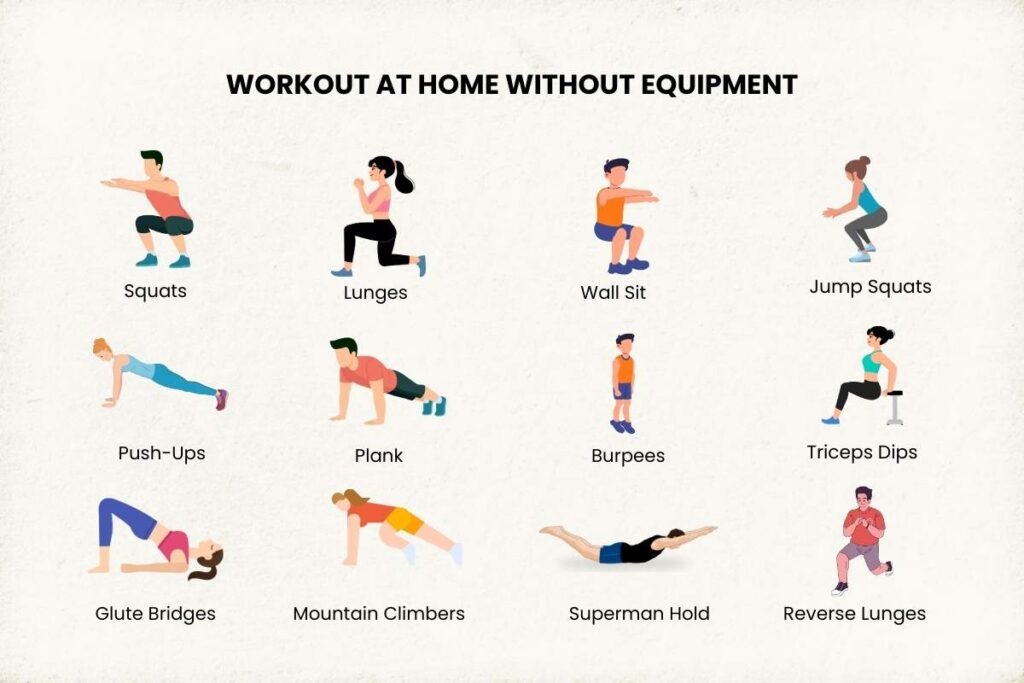
Push-Ups are the foundational upper body exercise that works your chest, shoulders, triceps, and core simultaneously. If standard push-ups are too challenging initially, start with wall push-ups or knee push-ups. Position your hands slightly wider than shoulder-width, keep your body in a straight line from head to heels, and lower yourself until your chest nearly touches the floor before pushing back up. Aim for three sets of as many repetitions as you can do with good form.
Tricep Dips can be performed using a sturdy chair or the edge of your couch. Sit on the edge, place your hands beside your hips, slide your bottom off the edge, and lower yourself by bending your elbows to about 90 degrees before pushing back up. This exercise specifically targets the backs of your arms and can help eliminate arm jiggle over time.
Plank Shoulder Taps combine core stability with shoulder and arm strengthening. Start in a plank position on your hands, then alternately lift one hand to tap the opposite shoulder while keeping your hips as still as possible. This challenges your balance while building upper body endurance.
Essential Home Workouts for Beginners: Lower Body
Your legs contain the largest muscle groups in your body, making lower body exercises crucial for overall fitness and calorie burning.
Squats are the king of lower body exercises, working your quadriceps, hamstrings, glutes, and core. Stand with feet shoulder-width apart, push your hips back as if sitting in a chair, lower until your thighs are parallel to the ground (or as low as comfortable), then drive through your heels to stand. Keep your chest up and knees tracking over your toes throughout the movement.
Lunges target similar muscles as squats but also challenge your balance and coordination. Step forward with one leg, lower your back knee toward the ground until both knees form 90-degree angles, then push back to the starting position. Alternate legs or complete all repetitions on one side before switching.
Glute Bridges specifically target your posterior chain, including glutes and hamstrings. Lie on your back with knees bent and feet flat on the floor, then lift your hips toward the ceiling by squeezing your glutes, creating a straight line from shoulders to knees. Hold briefly at the top before lowering back down.
Calf Raises strengthen your lower legs and improve ankle stability. Stand with feet hip-width apart and rise onto your toes, hold briefly, then lower back down with control. For added challenge, perform these on a step with your heels hanging off the edge to increase range of motion.
Essential Home Workouts for Beginners: Core
A strong core improves posture, reduces back pain, and enhances performance in all other exercises.
Planks are the most effective core exercise for beginners. Hold a push-up position on your forearms and toes, keeping your body in a straight line from head to heels. Engage your abs, glutes, and quads to maintain position. Start with 20 to 30 seconds and gradually increase duration as you get stronger.
Dead Bugs provide excellent core strengthening with minimal back strain. Lie on your back with arms extended toward the ceiling and knees bent at 90 degrees. Slowly lower your right arm overhead while straightening your left leg, hovering it just above the floor, then return to start and repeat on the opposite side. Focus on keeping your lower back pressed against the floor throughout.
Bird Dogs improve core stability and balance while also working your back muscles. Start on hands and knees, then simultaneously extend your right arm forward and left leg backward, keeping your hips level. Hold briefly, return to start, and repeat on the opposite side.
Creating Your Beginner Workout Schedule
Structure is essential for making home workouts for beginners effective and sustainable. Here’s a sample weekly schedule that balances different muscle groups while allowing adequate recovery:
Week 1-2: Foundation Phase
- Monday: Full body circuit (2 sets of 8-10 reps each: squats, push-ups, lunges, plank 20-30 seconds)
- Wednesday: Lower body focus (3 sets of 10-12 reps: squats, glute bridges, lunges, calf raises)
- Friday: Upper body and core (3 sets of 8-10 reps: push-ups, tricep dips, plank, dead bugs)
Week 3-4: Building Phase
- Monday: Full body circuit (3 sets, increased reps or harder variations)
- Wednesday: Lower body focus (3 sets with added single-leg variations)
- Friday: Upper body and core (3 sets with longer plank holds)
- Sunday: Optional light activity (walking, stretching, yoga)
As you progress beyond the first month, you can add a fourth workout day, increase sets and repetitions, incorporate harder exercise variations, or reduce rest periods between sets.
Common Mistakes to Avoid
Many beginners make preventable mistakes that hinder progress or increase injury risk. Doing too much too soon is perhaps the most common error. Enthusiasm is wonderful, but your body needs time to adapt. Start with manageable workouts and gradually increase intensity over weeks and months, not days.
Neglecting proper breathing is another frequent mistake. Many people hold their breath during challenging exercises, which increases blood pressure and reduces performance. Generally, exhale during the exertion phase (when pushing or lifting) and inhale during the easier phase (when lowering or relaxing).
Skipping rest days may seem productive but actually sabotages your progress. Your muscles need recovery time to repair and strengthen. Overtraining leads to burnout, injury, and plateaus. Rest days are when the magic actually happens.
Focusing only on what you’re good at or enjoy limits your overall fitness development. A balanced routine addresses all major muscle groups and movement patterns. Challenge yourself to include exercises you find difficult because those are often where you need the most improvement.
Staying Motivated and Tracking Progress
Motivation naturally fluctuates, so building systems that keep you consistent regardless of motivation levels is crucial. Setting specific, measurable goals helps maintain focus. Instead of vague goals like “get fit,” aim for concrete targets such as “complete 10 full push-ups” or “hold a plank for 60 seconds.”
Tracking your workouts provides tangible evidence of progress and helps identify when it’s time to increase difficulty. Use a simple notebook or phone app to record exercises, sets, repetitions, and how you felt. Looking back at where you started can be incredibly motivating when progress feels slow.
Finding an accountability partner, even virtually, significantly increases adherence to workout plans. Share your goals with a friend, join online fitness communities, or post workout updates on social media. Knowing someone else is expecting to hear about your workout makes you more likely to actually do it.
Celebrating small victories maintains momentum. Did you do one more push-up than last week? Hold your plank five seconds longer? Accomplish a workout on a day you really didn’t feel like it? These are all worth acknowledging and celebrating.
Nutrition Considerations for Home Workouts
While this guide focuses on exercise, nutrition plays a vital role in your fitness results. You cannot out-exercise a poor diet, and proper nutrition supports your workouts and recovery. Ensure you’re eating adequate protein to support muscle repair and growth, aiming for roughly 0.7 to 1 gram per pound of body weight daily from sources like lean meats, fish, eggs, legumes, and dairy.
Stay properly hydrated by drinking water throughout the day, not just during workouts. Dehydration impairs performance and recovery. A good rule of thumb is to drink half your body weight in ounces of water daily, plus extra to replace what you lose through sweat.
Time your meals appropriately around workouts. Eating a light snack containing carbohydrates and protein about an hour before exercising provides energy, while consuming protein and carbs within an hour after working out supports optimal recovery.
When to Progress Beyond Beginner Workouts
You’ll know you’re ready to advance beyond beginner home workouts when you can complete your current routine comfortably without excessive fatigue, your exercises feel easy even with good form, you’re no longer experiencing muscle soreness after workouts, and you’re consistently meeting your repetition and duration goals.
At this point, you can progress by increasing volume through more sets or repetitions, advancing to more challenging exercise variations like decline push-ups or pistol squats, reducing rest periods between exercises or sets, adding light equipment like resistance bands or dumbbells, or incorporating more advanced training methods like supersets or circuit training.
Conclusion: Your Journey Starts Now
Home workouts for beginners offer an accessible, effective, and sustainable path to improved fitness, strength, and health. You don’t need a gym membership, expensive equipment, or hours of free time to see real results. What you need is consistency, proper form, progressive challenge, and patience with yourself as you build this new healthy habit.
Remember that everyone starts somewhere, and every fitness influencer or athlete you admire was once a complete beginner too. The most important step is simply starting. Don’t wait for the perfect moment, the perfect plan, or the perfect level of motivation. Start with what you can do today, right now, and build from there.
Your body is capable of amazing changes when you give it consistent challenge and adequate recovery. Be patient with your progress, celebrate your improvements, and remember that the goal isn’t perfection but rather consistent effort toward becoming a stronger, healthier version of yourself.
Frequently Asked Questions
Q1: How long should home workouts for beginners last?
Beginner home workouts should typically last 20 to 30 minutes, not including warm-up and cool-down. This duration is sufficient to work all major muscle groups effectively without causing excessive fatigue or burnout. As you build endurance and strength over several weeks, you can gradually extend workouts to 45 minutes. Remember, consistency with shorter workouts beats sporadic longer sessions.
Q2: How many days per week should beginners exercise at home?
Beginners should aim for three to four workout days per week with at least one rest day between sessions working the same muscle groups. This schedule provides enough stimulus for fitness improvements while allowing adequate recovery time. You might structure this as Monday, Wednesday, Friday workouts with active recovery like walking or gentle stretching on other days. As you advance, you can increase to four or five days weekly.
Q3: Can you really build muscle with just bodyweight exercises?
Absolutely. Bodyweight exercises can effectively build muscle, especially for beginners whose muscles aren’t yet adapted to resistance training. Your body doesn’t differentiate between weight from barbells and weight from your own body. Exercises like push-ups, squats, and lunges create sufficient tension to stimulate muscle growth. Progressive overload through increased repetitions, slower tempo, or advanced variations continues challenging muscles as you get stronger.
Q4: What should I do if I feel sore after my first workout?
Muscle soreness after initial workouts is completely normal and expected. This delayed onset muscle soreness (DOMS) typically peaks 24 to 48 hours after exercise and gradually subsides. Continue with light activity like walking or gentle stretching, which actually helps reduce soreness by increasing blood flow. Stay hydrated, get adequate sleep, and ensure proper nutrition. Don’t let soreness prevent your next scheduled workout; light to moderate exercise can help you feel better.
Q5: Do I need to buy any equipment eventually?
While bodyweight exercises alone can take you far, adding minimal equipment after several months can provide variety and progression. Resistance bands ($10-20) are excellent first purchases, offering adjustable resistance for nearly every exercise. Light dumbbells or a pull-up bar are also worthwhile investments. However, none of these are necessary initially. Focus on mastering bodyweight movements first, then consider equipment if you want additional training options.
Word Count: 2,687 words